
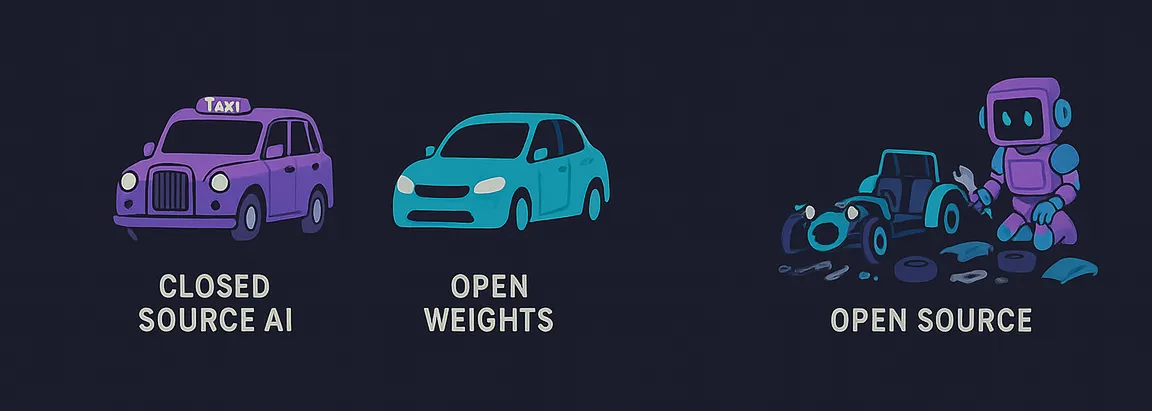
When people talk about AI models being "open" or "closed," they're usually collapsing three distinct concepts into one word. Closed source, open source, and open weight are not interchangeable terms. Each describes a different level of access, and the differences have real consequences for developers, researchers, and anyone building on top of these systems.
Closed Source Models
A closed source model is one where the provider gives you access to the model's capabilities through an API, but nothing else. You send a request, you get a response. What happens in between is entirely opaque.
GPT-4, Claude, and Gemini Ultra are the most prominent examples. You can use them, but you cannot inspect the weights, reproduce the training process, or run them outside the provider's infrastructure. The model is a black box, and your relationship with it is entirely mediated by the API.
This has practical implications:
- You depend on the provider's uptime, pricing, and policy decisions
- You cannot fine-tune the base model directly (only through interfaces the provider exposes)
- You have no visibility into what data the model was trained on
- If the provider changes the model or discontinues it, your application breaks
For many use cases, none of that matters. The models are powerful, the APIs are reliable, and the tradeoff is worth it. But for applications that require data privacy, offline deployment, or deep customization, closed source is a hard constraint.
Open Source Models
True open source, applied to AI, means the weights are public, the training code is available, and the training data is documented or released. The full stack is reproducible.
This is a high bar. Very few models actually meet it. EleutherAI's GPT-NeoX and the Pythia suite come close. BLOOM, released by BigScience, is another example. These models were trained on documented datasets, with code released under permissive licenses, and the weights made freely available.
The value of genuine open source is reproducibility and trust. You can verify claims about the model. You can audit the training data for biases or problematic content. You can retrain from scratch if you need to. Academic researchers can build on the work without depending on a commercial provider.
The tradeoff is that truly open source models have historically lagged behind closed source ones in raw capability. Training frontier models requires compute budgets that most open research efforts can't match.
Open Weight Models
Open weight is the category most people actually mean when they say "open source AI." The weights are public and downloadable, but the training data and code may not be, and the license often restricts commercial use or redistribution.
Meta's Llama series is the defining example. The weights are freely available, you can run them locally, fine-tune them, and build applications on top of them. But the training data is not fully disclosed, the training code is not released, and the license has conditions that vary by version.
Mistral, Qwen, Gemma, and Phi follow a similar pattern. Weights are public, but "open source" in the traditional software sense they are not.
This distinction matters for a few reasons:
- You can run open weight models on your own hardware, which means no API costs and no data leaving your infrastructure
- Fine-tuning is fully in your control, using techniques like LoRA or QLoRA on consumer-grade GPUs
- You can inspect the weights, but you cannot fully audit the model's behavior without knowing what it was trained on
- Licensing terms vary, and some models prohibit certain commercial uses
Open weight models have closed the capability gap with closed source models significantly over the past two years. Llama 3.1 405B, for instance, is competitive with GPT-4 on many benchmarks. That shift has changed the calculus for a lot of teams.
Why the Distinction Matters in Practice
The choice between these three categories is not just philosophical. It shapes what you can build and how.
If you're building a consumer product and need the best possible performance with minimal infrastructure overhead, closed source is often the right call. The API handles scaling, the models are state-of-the-art, and you can move fast.
If you're working in a regulated industry, handling sensitive data, or operating in an environment where data cannot leave your servers, open weight models are often the only viable option. Running Llama or Mistral locally means your data never touches an external API.
If you're doing research that requires full reproducibility, or you need to audit a model's training data for compliance or bias analysis, you need genuine open source. Open weight alone is not enough.
The lines between these categories are also shifting. Some providers have started releasing more of their training details. Some open weight licenses have become more permissive. The landscape in 2025 looks different from 2023, and it will keep changing.
A Quick Reference
| Closed Source | Open Weight | Open Source | |
|---|---|---|---|
| Weights available | No | Yes | Yes |
| Training code | No | Rarely | Yes |
| Training data | No | Rarely | Yes |
| Run locally | No | Yes | Yes |
| Fine-tune freely | Limited | Yes | Yes |
| Examples | GPT-4, Claude, Gemini | Llama, Mistral, Qwen | Pythia, BLOOM |
The word "open" in AI is doing a lot of work. Knowing which kind of open you're dealing with is the first step to making an informed decision about which model belongs in your stack.