If you have been following the AI space lately, you have probably heard these three terms thrown around a lot: tool calling, MCP, and skills. Sometimes they get used interchangeably. Sometimes people treat them like they are completely separate things. And if you are just getting into AI agents or building with LLMs, the overlap can be genuinely confusing.
So let me break it down the way I wish someone had explained it to me.
What Is a Tool Call?
A tool call is exactly what it sounds like. It is when a language model, instead of just generating text, decides to invoke an external function or API to get something done.
Think of it this way. You ask an AI assistant: "What is the weather in Manila right now?" The model does not know the current weather. It was trained on data with a cutoff. So instead of guessing or making something up, it calls a weather API, gets the real data, and then uses that to answer you.
That is a tool call. The model recognizes it needs external information or needs to perform an action it cannot do on its own, so it reaches out to a defined function.
Tool calls are structured. The model outputs something like a function name and a set of arguments in a format the system can parse and execute. The result comes back, and the model uses it to continue the conversation or complete the task.
This is what makes modern AI assistants actually useful for real-world tasks. Without tool calling, a model is just a very good text predictor. With it, the model can search the web, read files, write to databases, send emails, run code, and more.
What Is MCP?
MCP stands for Model Context Protocol. It is a standard introduced by Anthropic that defines how AI models communicate with external tools and data sources in a consistent, interoperable way.
Here is the problem it solves. Before MCP, every AI application had its own way of connecting to tools. One app would have a custom integration for a file system. Another would have a different one. If you wanted to plug a new tool into your AI workflow, you had to write a custom connector every single time. It was fragmented and hard to scale.
MCP is essentially a universal interface. It defines a standard protocol so that any MCP-compatible tool can plug into any MCP-compatible model or agent without custom glue code. Think of it like USB for AI tools. You do not need a different cable for every device. You just use the standard port.
An MCP server exposes a set of tools, resources, and prompts. An MCP client, which is usually the AI agent or the application running it, connects to that server and can discover and use whatever is available. The model does not need to know the implementation details. It just knows what tools exist and what they do.
This is a big deal for developers building AI-powered applications. Instead of maintaining a pile of one-off integrations, you build or use MCP servers and everything becomes composable.
What Are Skills?
Skills are a higher-level concept. Where a tool call is a single function invocation, a skill is a reusable, composable capability that an agent can perform, often made up of multiple steps, tool calls, and logic.
A skill might be something like "research a topic and summarize it." Under the hood, that skill might involve calling a search tool, reading several pages, filtering the results, and then generating a summary. From the outside, it looks like one thing the agent can do. Internally, it is a whole workflow.
Skills are how you build agents that can handle complex, multi-step tasks without you having to spell out every single step every time. You define the skill once, and the agent knows how to execute it when needed.
In frameworks like Microsoft's Semantic Kernel, skills are a first-class concept. You register skills with the agent, and it can plan and chain them together to accomplish goals. Other frameworks use different names, functions, actions, capabilities, but the idea is the same.
How They Relate to Each Other
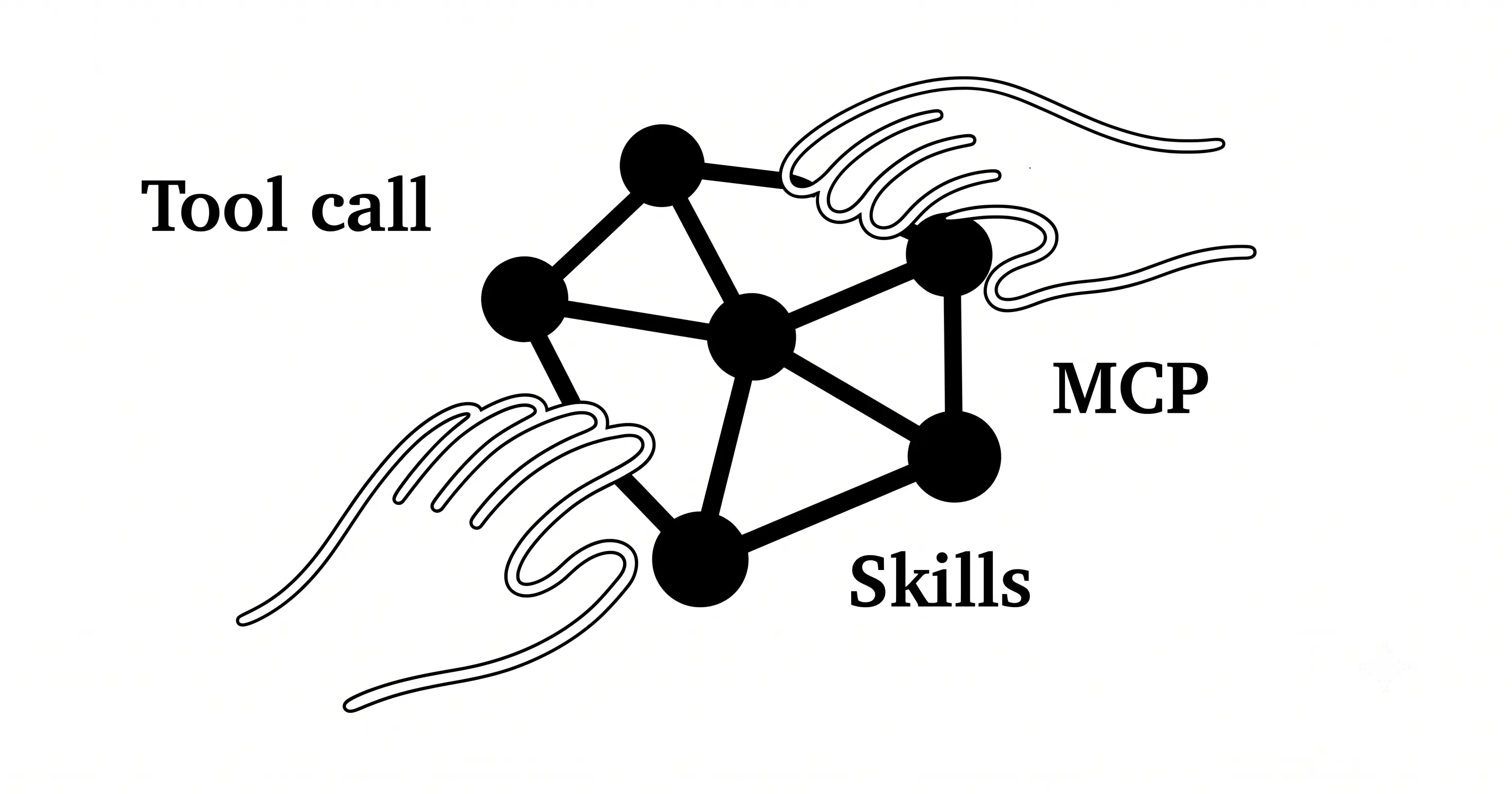
Here is a simple way to think about the relationship between the three:
Tool calls are the atomic unit. One function, one result. It is the lowest level of the stack.
MCP is the protocol layer. It standardizes how tools are discovered, described, and invoked across different systems. It makes tool calling interoperable.
Skills are the application layer. They are higher-level capabilities built on top of tool calls, often using MCP-connected tools, that let agents do meaningful, multi-step work.
You can have tool calls without MCP. You can have skills without MCP. But MCP makes the whole system more modular and easier to scale. And skills without tool calls are just static prompts, they need the ability to act to be genuinely useful.
Real Use Cases
Let me make this concrete with a few examples.
A coding assistant that can read your files, run your tests, and suggest fixes is using tool calls to access the file system and execute commands. If it is built on an MCP server that exposes those capabilities, any compatible agent can use the same setup. The "debug and fix" workflow it follows is a skill.
A research agent that takes a question, searches the web, reads relevant pages, cross-references sources, and produces a report is exercising a skill. Each search and each page read is a tool call. If the search engine and the browser are exposed via MCP, the agent can swap them out or extend them without rewriting the core logic.
A customer support bot that can look up order status, process refunds, and escalate tickets is using tool calls to hit your backend APIs. The "handle a refund request" flow is a skill. MCP could be what connects the bot to your internal systems in a standardized way.
Why This Matters for Developers
If you are building with AI right now, understanding these distinctions helps you make better architectural decisions.
Tool calls are where you define what your agent can do. Be deliberate about what you expose. Every tool you give an agent is a surface area for unexpected behavior, so keep them focused and well-described.
MCP is worth paying attention to if you are building anything that needs to integrate with multiple tools or that you want to be reusable across different agents or applications. The ecosystem is growing fast and the tooling is getting better.
Skills are how you think about agent behavior at a product level. What should this agent be able to do? What workflows does it need to handle? Defining skills clearly makes your agent more predictable and easier to test.
The line between these three will keep blurring as the tooling matures. But knowing the distinction helps you read documentation, debug problems, and have clearer conversations about what your AI system is actually doing.
Still Learning This Myself
I want to be honest: I am not an expert on any of this. I am a student who finds this stuff genuinely interesting and has been reading a lot about it lately.
What I do know is that the shift from "AI as a text generator" to "AI as an agent that acts" is real and it is happening fast. Tool calls, MCP, and skills are the building blocks of that shift. Understanding them, even at a surface level, puts you in a much better position to build with AI intentionally rather than just copying patterns you found in a tutorial.
If you want to go deeper, the Anthropic MCP documentation is a good starting point. So is the Semantic Kernel docs from Microsoft if you want to see how skills are implemented in practice.
I am still figuring this out as I go. But that is kind of the point.