
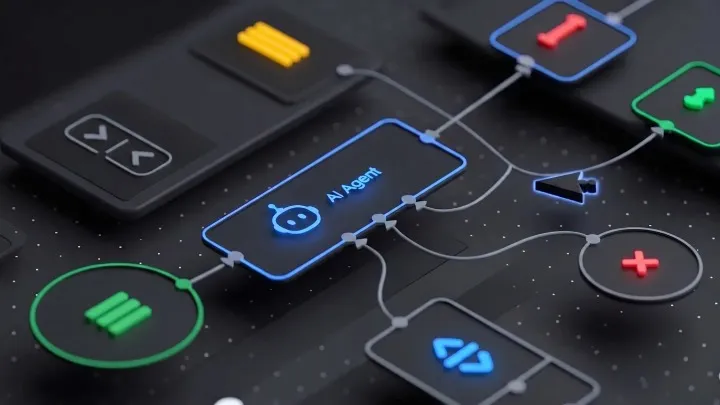
Most people's first encounter with AI is a chatbox. You type, it replies. Clean, simple, and honestly a bit limited. That interaction model works fine for answering questions, but it breaks down the moment you need something done, not just described.
That gap between knowing and doing is exactly what AI agents are designed to close.
So What Actually Is an AI Agent?
At its core, an AI agent is a system that can take a goal and figure out how to reach it, step by step, without you spelling out every action. It's not just generating text. It's making decisions, using tools, checking results, and adjusting course when something goes wrong.
Think of the difference between asking someone "how do I book a flight?" versus handing them your card and saying "book me a flight to Tokyo next Friday." The first is a chatbot. The second is closer to what an agent does.
Three things separate an agent from a plain LLM:
- Planning: it breaks a goal into steps and sequences them logically
- Memory: it tracks what it has already done and uses that context going forward
- Tool access: it can call APIs, run code, search the web, read files, and write back to systems
Put those three together and you get something that can operate with real autonomy on real tasks.
Why This Is Harder Than It Sounds
Building an agent that actually works reliably is a different problem from building one that works impressively in a demo.
The core difficulty is that LLMs are probabilistic. They don't follow a deterministic script. Every output is a sample from a distribution, which means the same input can produce different outputs on different runs. For a chatbot, that's fine. For an agent that's supposed to execute a multi-step workflow, that unpredictability compounds quickly.
A wrong decision at step two doesn't just affect step two. It affects every step after it.
This is why evaluation is so hard. You can't just run a benchmark once and call it done. You need to test across many runs, many edge cases, and many failure modes. And because the underlying models keep improving, it's often unclear whether better results came from your agent design or just from a model update.
Debugging is its own challenge. Agents can solve problems in ways that are technically correct but completely unexpected. The longer an agent runs, the more decisions it makes, and the harder it becomes to trace back where things went sideways.
The Different Shapes Agents Come In
Not all agents are built the same. The complexity of the task usually determines the architecture.
A simple reflex agent just maps inputs to outputs using fixed rules. No memory, no planning. Think of a linter: it scans your code, applies a ruleset, and flags violations. Fast, predictable, useful for narrow tasks.
A goal-based agent is more flexible. It takes a desired outcome and works backward to figure out what actions to take. AI-powered code completion tools fall into this category. They're not just autocompleting syntax. They're inferring intent and generating code that moves toward a goal.
A learning agent improves over time. It collects feedback, adjusts its behavior, and gets better at the task the more it runs. This is where things get genuinely interesting, because the agent isn't just executing a fixed strategy. It's refining one.
Multi-Agent Systems: Dividing the Work
A single agent handling a complex task is like one person trying to design, build, test, and ship a product alone. It's possible, but it's slow and error-prone.
Multi-agent systems split the work. One agent handles planning. Another writes code. A third runs tests. A fourth reviews output. Each agent is specialized, and they coordinate to reach a shared goal faster and more reliably than any one of them could alone.
The interesting property of this architecture is that failures stay contained. If the testing agent catches a bug, it doesn't bring down the whole system. It just flags the issue and routes it back to the agent responsible for fixing it.
This is the direction serious AI tooling is heading. Not one powerful model doing everything, but networks of focused agents working in parallel.
What This Means If You Write Software
Agentic AI is not a distant concept. It's already showing up in the tools developers use daily, and its presence will only grow.
The practical shift is this: a lot of the work that currently requires sustained human attention, writing boilerplate, scaffolding tests, triaging issues, reviewing PRs for obvious problems, is exactly the kind of structured, repeatable work agents are good at. That work doesn't disappear. It gets delegated.
What that frees up is time and attention for the parts of software development that actually require judgment: understanding what to build, why it matters, how it fits into a larger system, and what tradeoffs are worth making.
The developers who will get the most out of agentic AI are the ones who learn to work with agents the way a senior engineer works with a capable junior. Clear goals, good context, and enough oversight to catch mistakes before they compound.